Tuesday, February 19, 2013

Home School Immersion- Colonial Williamsburg

Teaching your own children brings to mind the old Proverb: "You can lead a horse to water, but you can't make him drink."  Traveling to teach our children about history and culture doesn't ensure they will learn it; all we can do is lead them to it and hope they drink...  Case in point: Our Williamsburg Visit.


     We shuffled our three kids and two dolls out the door and headed for the Royal Governor’s mansion.
     A persnickety man assuming we were the hired help answered Emma’s timid knock on the mansion’s front door.  It seemed there was a Royal Ball that evening and he was desperate.
     “From your casual attire, I can see you are not a guest of the Governor’s tonight so you must be the new servants.  Please come in and I’ll show you around,” he said as we entered the heavily armed foyer.  Swords, scabbards, pistols, and rifles lined the walls from floor to ceiling.  He explained that this was a customary display of the power of the British government and we would be expected to dust them later.  “Let’s go through to the ballroom.  I think Mrs. Brown, the housekeeper is there and she’ll find you more suitable clothing and better explain your duties for the night.  It is going to be a grand celebration of Queen Charlotte’s birthday.”
     Greg and I smiled as we followed the enthusiastic actor through the home.  The kids were mesmerized.  Emma pulled my sleeve as we walked and asked, “Are we really going to get some clothes like his?”
     I whispered, “Sorry, darling, but I don’t think so… that would be neat though, wouldn’t it?”  She giggled to hide her disappointment.
     The historical actor stayed in character throughout our tour of the mansion.  After a while, we let ourselves slip back in time to 1775.  He referred to the recent skirmish near Concord and Lexington and held all of Boston in complete contempt for their ungrateful behavior in the past few months.
     “How could anyone disrespect our King by dumping his tea into the water?  Disgraceful!”  He was definitely a loyalist. 
     As we wandered the rooms, I discovered I couldn’t stop grinning. Greg looked at me like I’d lost my mind.
     “Are you okay?”
     “I’m great.  I’m just happy.”
     “About what?” He wasn’t a history convert yet.
     “This is it.” I waved my hand around the beautiful ballroom with its portraits of the King and Queen flanking the double doors. I pointed at the kids standing near our guide with rapt attention as he told of the grand traditions of the British and complained about upstarts like Thomas Jefferson and George Washington who took it all for granted. “This is what I dreamed about for home school,” I whispered. “I have always wanted to teach by immersion.  Go and see places in person instead of just reading about them in books.  I just can’t believe we’re here.  We are actually doing it!”
     Greg and I trailed the others out into the gardens.  Wyatt spotted a maze and raced Emma to it.  Anabel sauntered through a vine-covered pathway.  Greg and I meandered around the King’s gardens and found our way to the kitchens where a woman was demonstrating beer making. The smell knocked me back as I entered the small outbuilding.  I decided to hang by the scullery door and listen rather see close-up.  She banked her fire and stirred a large pot full of water, grain, hops and yeast.  She explained that in colonial days everyone drank beer- even the children because the water was contaminated.  Brewers made two different types: a large beer- heavy ale or porter for adults and a small beer- very weak but bacteria free for children. The local brewers were usually cooks in the kitchens of larger estates and servants were sometimes paid with a stipend of weak beer.  Imported beers were for the wealthy while most common townsfolk drank a local brew.  George Washington reportedly loved porters and Thomas Jefferson preferred lighter ales.  I couldn’t wait for our dinner in the local pub to taste both to see with which founding father I agreed.
Brewing a pint...or two.
     The remainder of our day was spent along Gloucester Street in the shopping district of Colonial Williamsburg. The kids perused the 18th century wares and bought some costumes and games with the money they earned washing golf carts on Fripp.  We toured the home where Jefferson studied law and watched the blacksmith and wheelwright’s demonstrations.  As we neared the House of Burgesses, we noticed a shift in sentiment towards the British among the reenactments.  No longer were the town’s folk spouting praises for the King.  Minutemen were marching along the streets and drilling in the courtyard.  A man stood on an expounding plank talking of freedom and the rights of men.
     Our last stop was the Virginia Capital building where a riot had recently taken place.  The Royal Governor and his advisors had left in the middle of the night leaving their food still on their plates in their private meeting room. A few months prior, Patrick Henry delivered his “Give me liberty or give me death” speech during a covert meeting to the Virginia convention in Richmond and rebellion took hold in Williamsburg.  Patrick Henry was named the new governor and the capital building was the site of the first Declaration of Rights in America.  I tried to instill the magnitude of how awe-inspiring it was to stand where our founding fathers stood. 
     “Anabel, Thomas Jefferson studied law in this building.  Wyatt, this is where the first group of people agreed that all men were created equal and free.  Emma, Patrick Henry said in this room, ‘If this be treason, make the most of it!’  Can you imagine taking such a risk?  If they had been caught by the British they would have been killed!” I gave the kids a wide-eyed look for emphasis.  They stared back at me speechless.  I had them.  They were as interested in history as I.  

     Then, Emma opened her mouth and said, “Did they have ice cream in colonial times, Mommy?”
     Wyatt turned to his sister. “Ooo!  I’d really like some ice cream!”
     Anabel shook her head as if coming back from a daze. “Are we getting ice cream? I want some.”

Oh well, I had them for a moment, which was better than never at all.


**This is an excerpt from my upcoming memoir about our family field trip year.  Check out the original blogs from our trip to Colonial Williamsburg:


Tuesday, February 5, 2013

Book Club- Traveling with Pomegranates by Sue Monk Kidd*


The Desperate and Downtrodden Book Club- Episode 2- Traveling with Pomegranates by Sue Monk Kidd

Fade in theme music. Roll opening titles. Cue Host.

Host- Welcome to The Desperate and Downtrodden Book Club!  On this show, we explore books that inspire and uplift the desperate and downtrodden. Please welcome my guest, best known as the author of the New York Times Bestsellers, The Secret Life of Bees and The Mermaid’s Chair, Sue Monk Kidd!

Pause for audience applause.

Sue Monk Kidd- Hello, Everyone!  Thanks for having me on your show, Jenny.
Host- I am so pleased to have you here to discuss your latest work- Traveling with Pomegranates: a mesmerizing memoir of a mother and daughter struggling with transition- you turning 50 and realizing you needed something more in your career and your daughter, Anne, leaving the security of college, unsure of her future, and facing failure for the first time.  How was it working with your daughter?
Sue Monk Kidd- It was fantastic when she wasn’t depressed and I wasn’t self-absorbed in my own fears of failure in writing my first novel.
Host- Wow!  Thanks for being so honest, Sue.  We don’t often get that on television. As a career woman and a mother, I gleaned motivation from both of your mêlées with life.  I related to Anne’s crippling uncertainty of her life’s ambition and your all-consuming need for more substance in your career.  How did traveling Greece and Turkey facilitate your choices?
Sue Monk Kidd- Traveling puts relationships in a pressure cooker.  You can’t hide your emotions for long on a three-week tour; eventually, your inner thoughts come out.  Although difficult, it is cathartic. Also, traveling allows you to explore new facets of your soul.  I have always gravitated to the spiritual and seek out locations that feed my chi. Greece and Turkey are teeming with transcendent locales.  Put family and spiritual journeys together and you have a recipe for change.
Host- So if someone was burned out and bored with her life, would you recommend traveling with her family to facilitate her deep-seeded need for change?
Sue Monk Kidd- I would tell that woman to set forth on her journey and not look back.  As Auntie Mame said, “Life is a banquet and most poor suckers are starving to death.”
Host- So you're telling me to do it- quit my job and spend a year traveling with my family and searching my soul for answers to what to do during my next stage in life.
Sue Monk Kidd- I didn’t say…
Host- That’s all the time we have today. 
Sue Monk Kidd- But, I…
Host- Thank you so much, Ms. Monk Kidd, for being my second guest.  Her life-altering book is Traveling with Pomegranates. If you are seeking a new life, The Desperate and Downtrodden Book Club also recommends Eat, Pray, Love by Elizabeth Gilbert, my debut guest- don’t cheat yourself by just watching the movie; Julia Roberts is great, but it glosses over her spiritual search- and Under the Tuscan Sun by Francis Mayes - if you’re pressed for time, this one is okay to just watch the movie; the film demonstrates three-act life renewal better than the eloquent, but elongated Mayes memoir.  (I mean she goes on and on about renovations and Etruscan tombs and never shows us her life.)  Tune in next time when my guest will be the ghost of Jane Austen.

Fade in music. Roll end credits. Fade out.

* The author wishes to be truthful and admit that although she met Sue Monk Kidd at an author’s luncheon at the University of South Carolina- Beaufort, she did not conduct an interview with her about her book.  The actual conversation went something like this:
Author- I loved The Secret Life of Bees!
Sue Monk Kidd- Thank you, I’m so pleased to hear that.
Author- (Handing Ms. Monk Kidd a new copy of Traveling with Pomegranates for her to sign) When I was a girl, I had bees in my closet, too.  Sometimes at night, I can still hear their buzzing.
Sue Monk Kidd- (Smiling as she hands the signed book back) Small world; I hope you enjoy my new book.
Author- Thank you, I’m sure I will.

Sunday, January 27, 2013

From the Mouths of Babes*

A sleeping child is a beautiful thing.
Kids are hard work.  They wear on your nerves, test your patience and put a constant strain on your pocketbook.   With kids around, the laundry piles to the ceiling and the cupboard is always bare.  That box of crackers you bought for the cheesy chicken casserole for dinner is gone thanks to the neighborhood kids and your daughter's giving nature.   She cut up all the cheese, too, so you'll have to go back to the store.  Oh, and there is no milk for your coffee... again.

Kids have never ending needs that must be met.  One kid perpetually asks, "What's for dinner?" even though you just fed them yesterday.  One kid has outgrown their shoes even though you bought the last pair two sizes too big. Another kid has the unmitigated gall to ask you to help them with social studies homework even though you spent an hour with them the night before going over slope-intercept form in math.  Must you help with social studies, too?   Good grief!


So why do we put up with them?  


Because they are pretty darn funny.  Greg and I would have kicked ours out years ago if they were not so entertaining.  While writing about our family sabbatical year, I stumbled upon several gems that endeared us to our children long after their cherub faces thinned and they became too big to cuddle.  Here are some of my favorites:

Overheard from the Mouths of Babes-

While playing with their dolls:
Anabel: Do babies really say goo-goo, gaga?
Emma: Yes, but only the stupid ones.

While playing Wii Party: 
Wyatt: I can't help it that I'm good at it.
Anabel: You're just good at being lucky.  How much skill does it take to press a button and have the spinner land on your number?
Wyatt: More than you'd think actually...

While trying to steal my book light:
Mommy: Put that back.
Emma: Can I just use it tonight?
Mommy: No, you'll lose it.  You can buy your own light with the $50 you have.
Emma: I wouldn't spend my $50 on a book light.
Mommy: Why not? They're only $3.
Emma: That's exactly why I wouldn't spend $50 on one.

While getting ready for bed:
Emma: Can I get some of the tools dentist use?
Mommy: Why? Do you want to be a dentist when you grow up?
Emma: It would be fun, but I don't think they'd let someone who's had so many cavities be a dentist. Or would they? I'd know more about it than a kid who never had any.

While trying to talk my husband into taking me to a movie for date night: 
Greg: I don't know.  What movie do you want to see?
Me: The one with Bradley Cooper.
Wyatt: Ooper Duper! (Said just like Peter Boyle's monster in Young Frankenstein.)

As long as they keep the laughs coming, I guess we'll let them hang around...  Laughter may not fold the clothes, but it sure helps it go a little faster.


*For those readers with no sense of humor, this post was written with my tongue firmly in my cheek.  I love my kids dearly and would never kick them by the wayside.  Greg, on the other hand...

Saturday, January 12, 2013

Road Scholars: A Sampler of Learning in Colonial Williamsburg


      Founded in 1699 as Virginia’s new colonial capital, Williamsburg thrived under colonial economics.  The proximity of the bustling port of Yorktown and America’s first successful colony, Jamestown caused early leaders to choose the site of Middle Plantation, Williamsburg’s original name, for the home of Virginia’s first university- The College of William and Mary founded in 1693.  After the burning of the state house in Jamestown in 1698, William and Mary students lobbied to have the colonial capital relocated near the college and thus, Williamsburg, named for King William III of England, was born.  It soon became the southern center for politics, culture and education. Mixing those three powerful ingredients into one location produced a haven for thought leaders of the American Revolution. George Washington, Thomas Jefferson, and Patrick Henry all cut their teeth in the pubs of Williamsburg before heading to Virginia’s House of Burgesses and on to the Continental Congress.  As we entered the preservation area just off North England Street, I wanted to instill the fact that our nation’s founding fathers walked the very streets we traversed. The idea of humans having the fundamental rights of life, liberty and the pursuit of happiness began in this town. I had goose bumps.  Greg had a headache.  Yesterday’s long drive through a deluge of rain did not improve his interest in history.  I determined to convert him along with the kids.

      “The guide says start in the Gateway Building.  Ooo! It’s got a kid’s corner with hands on activities!  Let’s go check it out!” Grabbing Emma’s hand, I marched my clan into our first stop. To their credit, they smiled, feigning interest, which I took as a show of appreciation of all the hard work I had done in planning this trip.  Mothers always wanted to believe the best of their family.

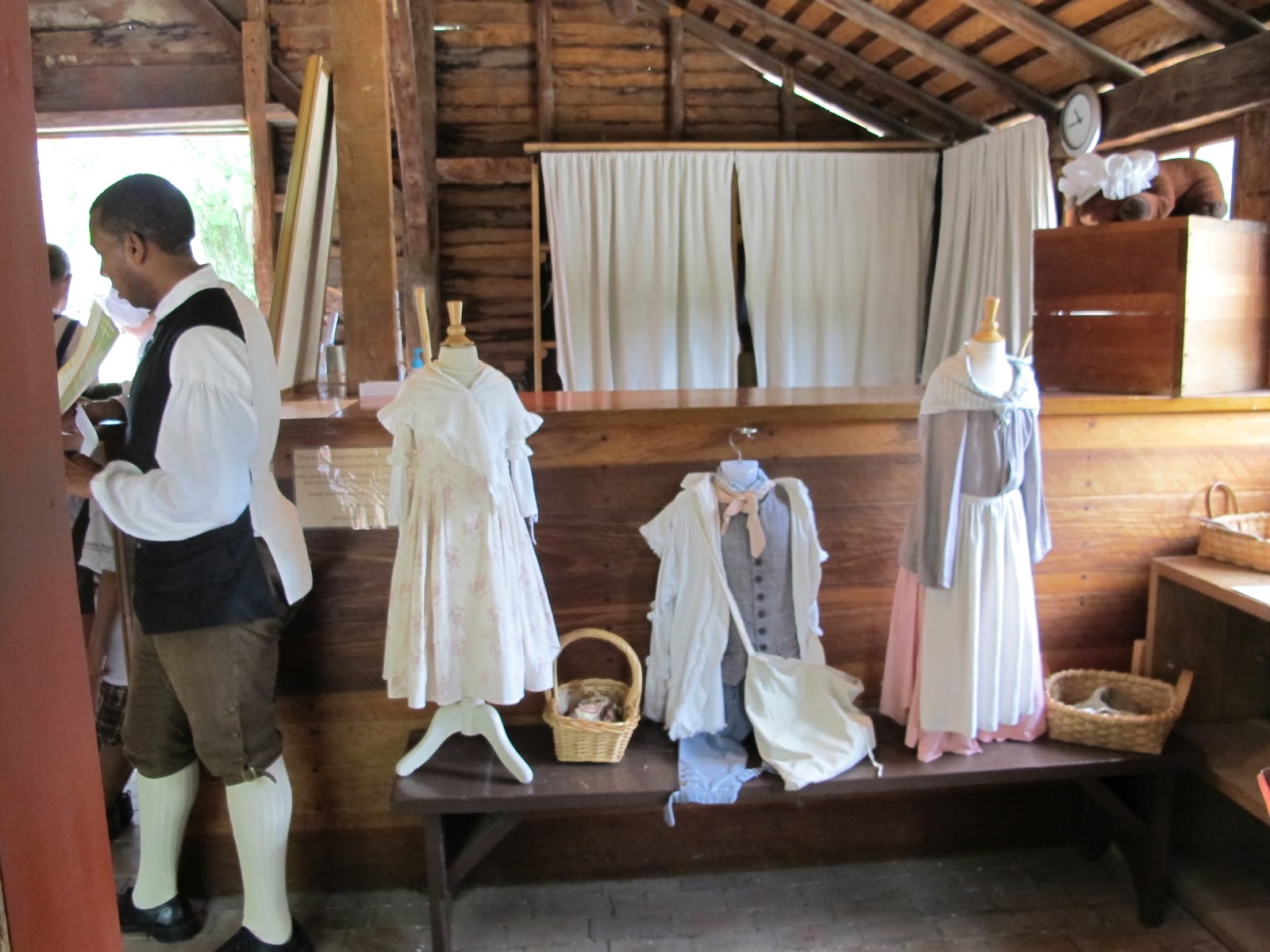
      An 18th century costumed citizen offering to show Emma and Anabel the sewing nook met us inside the door of the dimly lit, barn-like structure. I followed the girls while Greg and Wyatt gravitated to the large Frenchman's map of the town from the seventeen hundreds.  Since Montessori school, Wyatt had a fascination with maps.  He and his dad oriented themselves with the lay of the surrounding land.  Williamsburg was built on high ground in the middle of the Virginia peninsula almost equidistant to Yorktown and Jamestown forming one corner of the Historic Triangle.  Studying the map, one could easily see why the current location was much more desirable to Jamestown’s early settlers.  Jamestown was built on the banks of a mosquito-ridden marshy area off the James River.  How colonists survived the bloodletting, much less the malaria was a miracle.  I was thankful the reproduction map did not include the modern addition of Bush Gardens Park; I had omitted mentioning an amusement park was nearby.  Wyatt lived for roller coasters, but I wanted new family learning experiences this year- not the same old melting from the heat while standing in a long line reading t-shirts and tattoos.

      “Mommy, look what I made!”

      I turned from the map to see Emma holding a perfectly stitched letter E.  Most might have thought it was a C or an F; I could have agreed with them if they'd said a G even, but I knew it was the most beautiful E I’d ever seen. 

      “It’s E for Emma and E for Elizabeth, too.”  Emma had also brought her colonial American Girl doll, Elizabeth -Felicity’s best friend, with her to enhance the Williamsburg experience.  We had a three-week supply of school assignments, clothes, DVDs, granola, juice boxes and wine crammed in the car already.  What difference did two dolls in fragile, historical costumes make?

      “I can see that.  Good job!  You’re quite a little seamstress.  Are you ready to make a whole sampler?”

      “What’s a sampler?”

      “See that picture on the wall with the alphabet and numbers?  That’s called a sampler because it was a sample of all different kinds of stitches and patterns used for making their own clothes and decorations.  Girls used spent their free time practicing their sewing.  They couldn't go to the mall to buy their dresses.  They had to sew them.”  We stepped closer to the framed sampler to see the individual stitches.   

      “That must have taken a long time – like all day,” Emma said.

      “Emma, you don’t have a clue.  That must have taken a week to do all that.” Anabel didn’t want to grow up, but she relished being the big sister who thought she knew everything or at least more than her eight-year-old sister.


A Sample of a Sampler
      “Girls.  Look at the intricate designs.  Sure, there’s the simple alphabet and numbers that may not have taken weeks to finish, but look at the vines scrolling around the outer frame.  Look at the animals across the bottom.  The girl who made this took her time.  She didn’t rush to finish so she could watch TV or talk on the phone.  She focused on one activity and put herself in her work.  I bet these were the animals she saw outside her window.”  Deer, dogs, and birds of a variety species peppered the lower half in blues, greens and browns.  Flowers popped up along the vines in reds, yellows and pinks.  This was a work of art by Betsy- age 12.  Suddenly, I longed for the stillness of mind and body to create such beauty.  Could a 21st century, multi-tasking woman slow down enough to handle such tedious work?  I couldn’t go forty-five minutes without checking my phone (My sister bet me. I only made it twenty-nine minutes and I lost ten bucks. Sucker bet.) It was highly doubtful I could sit still long enough to accomplish Emma’s letter E.